
What Kim Jong Un's Visit to the Sinuiju Greenhouse Farm Reveals

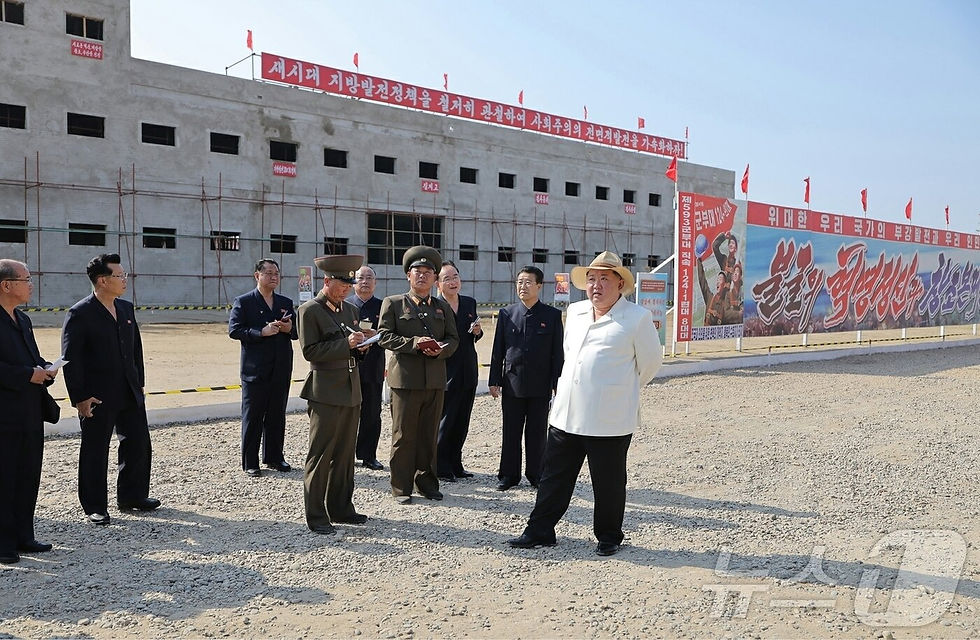
[Rodong Sinmun / News1] Kim Jong Un, General Secretary of the Korean Workers' Party, conducting on-site guidance at the Sinuiju Comprehensive Greenhouse Farm on May 31. |
Korean Workers' Party General Secretary Kim Jong Un conducted on-site guidance at the Sinuiju Comprehensive Greenhouse Farm in North Pyongan Province on May 31. This marked his third visit this year. Including the groundbreaking ceremony held in February of last year, Kim has visited the site on five separate occasions. Earlier this year, he made the farm the destination of his first on-site guidance of the new year and personally attended the completion ceremony in February as well. North Korea constructed a residential complex—approximately 1.5 times the area of Yeouido (2.9 km²)—and a large-scale greenhouse farm on Wihwa Island in Sinuiju City, which had suffered catastrophic flooding in the summer of 2024. At the 9th Party Congress held last February, the farm was hailed as a "model creation of the era of national revival" representing triumph over disaster.
A close examination of North Korean media reports and more than thirty photographs released reveals several noteworthy details.
◆ Two Agendas: Farm Management and New Construction
During this on-site guidance, General Secretary Kim inspected two matters. The first was the state of the farm's operational management. The second was the construction progress of newly built healthcare facilities, a general services center, and a vegetable processing factory in the farm district—projects undertaken as part of the local development policy. He toured the greenhouse farm, passed through a newly established rapeseed field, and proceeded to the construction sites.
Touring various types of hydroponic and soil-based greenhouses, as well as experimental cultivation houses, Kim examined in detail the farm's production and vegetable science research processes and management conditions. He then observed that "in vegetable production, the most pressing issue is to minimize energy consumption while ensuring the efficient and optimal growing environment suited to the cultivation conditions of each crop variety, thereby reducing costs and enabling year-round vegetable cultivation." He went on to raise as tasks the issues of electricity, cost, and year-round cultivation in the production process, alongside variety diversification, expanded mechanization of operations, automation of transport, and the expansion of vegetable storage facilities and sales outlets.
◆ Power Shortage: Only 44% of the Farm in Operation?
These observations partially corroborate reporting by Radio Free Asia (RFA) and several other media outlets, which analyzed satellite imagery taken in March and concluded that only 44% of the Sinuiju farm was operational due to electricity shortages. This is because the issues Kim cited—electricity, cost, and year-round cultivation—are all linked to greenhouse operations during the winter months. In other words, the farm is not yet running normally during the approximately three to four winter months when large amounts of electricity are required to maintain greenhouse temperatures.
Nevertheless, rather than reprimanding the current level of farm operations, Kim spoke highly of the dedication of the agricultural workers. He expressed satisfaction with the achievements—noting that although much remains lacking, the farm had been "harvesting hundreds of tonnes daily of dozens of varieties of vegetables across more than 1,150 greenhouses at the Sinuiju Comprehensive Greenhouse Farm, regularly supplying nurseries, childcare facilities, primary schools, and commercial units, thereby contributing to improving the dietary life of the local people." North Korea appears to have designated the electricity supply problem—difficult to resolve immediately—as a medium-to-long-term challenge.
◆ Rapeseed Fields: Addressing Critical Cooking Oil Shortages
Following the greenhouse tour, Kim inspected a rapeseed field in full bloom adjacent to the farm. Given that North Korea faces a severe shortage of cooking oil and relies on significant imports, this appears to be an attempt to supplement the deficit through domestic rapeseed oil production. The large-scale cultivation of rapeseed for purely ornamental purposes is unlikely.
◆ 50% Complete: Healthcare, Service, and Processing Facilities
Kim subsequently toured the general services center, hospital, and factory building in the Wihwa Island district, currently approximately 50% complete. After inspecting the buildings under construction, he assessed that "when the modern hospital, multifunctional services center, and specialized vegetable comprehensive processing factory are completed, the Wihwa Island district will once again be inscribed as a model and standard of local transformation in the new era."
At the 9th Party Congress, North Korea designated as construction-sector tasks the building of 370,000 units of housing, more than 300 local industrial factories, more than 60 fish farming facilities, more than 100 schools and hospitals, and the renovation of Pyongyang City over the next five years. Although the Wihwa Island district is not a county (gun)-level unit, the intention appears to be to make it the target project for the third year of the local development policy—forging it into a new "model."
◆ Military Construction Units and Their Potential Role in Russian Reconstruction
Particularly notable is the passage in which Kim, after touring the construction sites, praised the fact that "the expertise of the construction units has been elevated to a higher level and the ranks of skilled workers have been strengthened." North Korea established '124th Regiments' within each corps and corps-level unit of the Korean People's Army for the purpose of local factory construction in county-level areas. The experience accumulated by these military construction personnel is assessed as likely to be utilized in the reconstruction of Russia and occupied territories following the conclusion of the Russia-Ukraine war.
◆ High-Level Entourage: Sinuiju as a National Model
The on-site guidance was accompanied by a large contingent of Party Central Committee Secretariat secretaries, reflecting keen interest in developing the Sinuiju greenhouse farm district as a model and disseminating it to other localities. Among the eleven secretaries, those confirmed to have accompanied Kim include Kim Jae-ryong (Organization), Ri Il-hwan (Propaganda), Jŏng Kyŏng-t'aek (Military Affairs), Sin Yŏng-il (Discipline), and Chu Ch'ang-il (Workers' Organizations), as well as Agriculture Director Ju Ch'ŏl-gyu and General Affairs Director Kim Yo Jong. First Lady Ri Sol Ju, daughter Kim Ju Ae, and Vice Director Hyŏn Song Wŏl were also in attendance.
The on-site guidance conducted with such a large entourage may reflect a grand vision that extends beyond the construction of the greenhouse farm district—namely, the development of Sinuiju City as a 'border gateway city.' The development of Sinuiju, long delayed by the COVID-19 pandemic and the state of China-DPRK relations, may now be back on track. During his 2018 on-site guidance visit to Sinuiju, Kim received a briefing on the 'General Construction Plan for Sinuiju City,' ordered revisions, and directed that construction of the border city be completed within a few years.
◆ Xi Jinping Visit Rumors and the Tumen River Access Question
The timing of Kim's visit to Sinuiju—coming in the wake of speculation about a visit to Pyongyang by Chinese President Xi Jinping—is also noteworthy. In a joint statement adopted following Xi's summit with Russian President Putin in Beijing on March 20, the two leaders stated that they would "continue trilateral consultations with Korea (North Korea) on the issue of Tumen River sea access in accordance with the 1991 agreement on the eastern section of the border." This is directly linked to the question of securing a maritime route for China to the East Sea. For China to resolve the 'Tumen River sea access' issue, North Korea's consent is indispensable—and in exchange for that consent, China could embark on large-scale economic cooperation with the North.
This issue could also lead to progress on the 'Tumen River-Primorsky Krai Development Project,' involving North Korea, China, Russia, and other multilateral participants. North Korea has recently been showing deep interest in economic exchange with China centered on Sinuiju and economic cooperation with Russia linking Rason City and Primorsky Krai. Belarusian President Alexander Lukashenko, who visited Pyongyang in late March and held talks with General Secretary Kim, recently noted in a meeting with Oleg Kozhemyako, Governor of Russia's Primorsky Krai, that "we very much hope that Primorsky Krai will play an intermediary role in trade with Korea (North Korea)," adding that "General Secretary Kim expressed support for this idea."
The reconstruction of Sinuiju City—which includes the modernization of the railway station and Uiju Airport—must necessarily proceed year by year and stage by stage. For tangible results to be achieved in the short term, cooperation with China is above all critical.
[Rodong Sinmun / News1] Kim Jong Un conducting on-site guidance at the Sinuiju Comprehensive Greenhouse Farm on May 31. |
◆ Kim Ju Ae: Successor Training or Daughter's Privilege?
A photograph taken as the entourage walked through the rapeseed field shows Kim Ju Ae walking immediately beside General Secretary Kim, Ri Sol Ju in the middle of the group, Vice Director Hyŏn Song Wŏl behind her, and Director Kim Yo Jong bringing up the rear.
In keeping with recent precedent, Kim Ju Ae was positioned to walk directly beside the General Secretary and listen to explanations—a scene strikingly reminiscent of how Chairman Kim Jong Il, then a university student in the early 1960s, accompanied his father, President Kim Il Sung (then Premier), on visits to rural areas and military units. In those days, Chairman Kim Jong Il would sometimes be seen photographing scenes with a camera or taking notes in a notebook during such visits. Kim Ju Ae has not yet been observed recording instructions in a notebook as other officials do.
According to the testimony of Hwang Jang-yop, former secretary of the Korean Workers' Party, Kim Jong Il had access to the central Party headquarters from his middle school years and, when accompanying Premier Kim Il Sung on a visit to Moscow in 1959 (at age 17), was reportedly already issuing specific instructions to aides and attendants gathered around him—at a time when Kim Jong Il was not being mentioned at all as a potential successor.
General Secretary Kim Jong Un also accompanied Chairman Kim Jong Il on on-site guidance visits, though this was not made public at the time. Based on historical precedent, it is difficult to render a hasty judgment on whether Kim Ju Ae is accompanying the General Secretary in her capacity as his daughter or is receiving succession training. Even if succession training is underway, given her age, the road to formal designation as successor remains long. What is clear, however, is that Ri Sol Ju and Director Kim Yo Jong are deliberately acting in ways that draw attention to Kim Ju Ae.
◆ Hyŏn Song Wŏl: The New Protocol Chief
Vice Director Hyŏn Song Wŏl of the Propaganda and Agitation Department (Events Division, estimated), who accompanies the General Secretary on nearly every on-site guidance visit, appears to be assuming the role of practical protocol manager for the Chairman of the State Affairs Commission—a role previously held by Kim Ch'ang-sŏn, Director of the State Affairs Commission Protocol Department, who passed away in December of last year.
◆ Kim Yo Jong: Quiet Power Behind the Throne

[Rodong Sinmun / News1] Kim Jong Un conducting on-site guidance at the Sinuiju Comprehensive Greenhouse Farm on May 31. |
The standing and role of General Affairs Director Kim Yo Jong within the Party also warrants attention. Scenes of her positioned at the very back of the entourage—as in this Sinuiju farm guidance visit—are frequently captured; yet at the 9th Party Congress, Kim Yo Jong was promoted to the position of Alternate Member of the Politburo and concurrently Director of the General Affairs Department, suggesting that her scope of activity has in fact expanded. Although she has stepped down from the State Affairs Commission, Director Kim continues to issue statements on foreign and inter-Korean policy and has been observed securing agreements signed by the General Secretary at summit meetings. Given that the head of the General Secretary's Secretariat has not been made public, it is reasonable to say that she is in practice serving as acting head of the Secretariat.
The Party General Affairs Department, which she now heads, is responsible for distributing and comprehensively managing the General Secretary's instructions and Party directives, and for monitoring the state of their implementation. Practical management of key Party documents is also handled by the General Affairs Department in collaboration with the General Affairs Section of the Party Organization and Guidance Department.
North Korean Party officials are required to produce various types of reports and meeting materials, including the Report on the Fulfillment of the People's Economic Plan, the Guidance Work Outline, the Guidance Work Summary Report, and Notifications. The most important of these is the Implementation Plan for the Supreme Leader's Instructions. This plan is drawn up when new instructions or directives from the General Secretary are received and measures for their implementation are deliberated. According to internal North Korean documents, two principles must be observed in preparing this plan:
"First, to clearly and specifically articulate the direction of activities of the relevant unit for the fulfillment of the instructions; and second, to mobilize to the maximum the reserves and potential latent in the relevant departments and units so as to establish a plan capable of thoroughly fulfilling the instructions in a short period of time." |
In accordance with these principles, the Implementation Plan for the Supreme Leader's Instructions must specify the dissemination and study of directives within the Party, deliberation for implementation, the period of implementation, and those responsible for implementation. It must also set out in concrete terms how political work and administrative organizational guidance work are to be conducted in order to fulfill the directives. The final section must clarify when and in what form and manner interim and final reviews are to be conducted.
Ordinarily, the Implementation Plan is prepared and directed by the Organization and Guidance Department, but the General Affairs Department may intervene to monitor the state of its implementation. In particular, now that Kim Yo Jong—regarded as Kim Jong Un's closest confidante—has been appointed as General Affairs Director, the scope of the General Affairs Department's intervention is likely to have grown considerably compared to the past. If the Department judges the state of implementation to be unsatisfactory, it may also demand that the Inspection Section of the Organization and Guidance Department conduct an inspection of the relevant unit.
Just as the successive Chiefs of Staff to the Blue House in South Korea exercised enormous influence far exceeding their official rank in the formal hierarchy—earning the nickname 'gatekeepers of power'—General Affairs Director Kim Yo Jong occupies a position that, while nominally lower in rank than the Organization Secretary (once considered the Party's second-in-command), enables her to wield considerably greater power. This likelihood is even greater under the current system headed by Organization Secretary Kim Jae-ryong, who lacks a clear power base within the Party, now that former Organization Secretary Cho Yong-wŏn has moved to the position of Chairman of the Standing Committee of the Supreme People's Assembly.
The image of Director Kim Yo Jong not stepping to the fore but accompanying the group from the very back is likely not a sign that her authority has been curtailed by the emergence of Kim Ju Ae—but rather that it has been strengthened, leading her to exercise deliberate restraint. Through the revised Party Rules adopted at the 8th Party Congress in 2021, North Korea established the position of 'First Secretary of the Party Central Committee,' who serves as 'deputy to the General Secretary.' Although no one has yet been formally appointed as First Secretary, it would not be an overstatement to say that General Affairs Director Kim Yo Jong is in practice fulfilling the role of First Secretary.
Source: “Reading North Korea” column by Jung Chang-hyun (News1)
Jung Chang-hyun | Director, Peace Economy Research Institute Historian and journalist. Graduated from the Department of Korean History, Seoul National University; completed doctoral coursework at the same institution. Currently Director of the Peace Economy Research Institute. Has pursued research, writing, and journalistic activities in the fields of inter-Korean relations and modern North Korean history for nearly 30 years. |


Comments