
North Korea's Transformation, Seen Across the Amnok River
FIELD REPORT
North Korea's Transformation, Seen Across the Amnok River
Jung Chang-hyun | Director, Peace Economy Research Institute

From July 23 to 25, the author traveled along the Amnok (Yalu) River from Ji'an City in China's Jilin Province to Dandong City in Liaoning Province, surveying Manpo City in North Korea's Jagang Province, the Supung and Ch'ŏngsu Workers' Districts in Saju County of North Pyongan Province, and Uiju County and Sinuiju City.
This region suffered massive damage from record-breaking rainfall and Amnok River flooding in late July of last year, and is now the focus of intensive flood recovery and new housing construction. It is also home to a number of designated economic development zones, including the Manpo Economic Development Zone, the Ch'ŏngsu Economic Development Zone, and the Amnok River Economic Development Zone.
This reporting trip found that, beyond simply recovering from last year's flood damage, North Korea is now carrying out embankment construction along the Amnok River aimed at fundamentally preventing future flooding. The country has completed construction of more than 15,000 housing units and has newly built large-scale vegetable greenhouse farms along with schools, hospitals, and other educational and service facilities.
◆ Amnok River Economic Development Zone Plans: Over a Decade Without Progress
On July 23, the waters of the middle Amnok River — flowing between China's Ji'an City and North Korea's Manpo City — had swollen considerably. Reportedly, more than 150 mm of rain had fallen in the area three days earlier. Beyond Pŏldŭngdo, a river island, a North Korean village came into view. Houses in the village, which had suffered flood damage the previous year, had been newly rebuilt as two- and three-story buildings.
 A village on the Amnok River bank in Manpo City, Jagang Province, seen beyond the river island of Pŏldŭngdo. These houses were newly built after last year's flood damage. (Photo courtesy of the Peace Economy Research Institute) |
In 2013, North Korea announced the establishment of the Manpo Economic Development Zone on a roughly 3 km² site spanning Pŏldŭngdo and parts of Mitari and P'osangri in Manpo City. The plan envisioned a development zone centered on modern agriculture, tourism and recreation, and trade. However, apart from the construction of a new bridge connecting Ji'an and Manpo, there has been no progress whatsoever in the twelve years since.
Until the COVID-19 pandemic struck in 2020, a same-day tour package covering downtown Manpo and the Kosanjin historical site had been in operation, but this has since been suspended. Beyond a deteriorating international environment — including instability in China-North Korea relations and international economic sanctions against North Korea — this appears to be linked to North Korea's shift in economic opening policy toward a line of self-reliance.
In front of the Ji'an customs house, several trucks could be seen waiting to enter North Korea, suggesting that cross-border logistics between China and North Korea are gradually picking up.
 Map showing the locations of the Manpo Economic Development Zone and the Amnok River Economic Development Zone, both economic development zones along the Amnok River announced by North Korea in 2013. (Map courtesy of the Peace Economy Research Institute) |
The following day, the author headed to the Supung Dam, located between Saju County in North Pyongan Province and Kuandian County in China's Dandong City. From in front of the Supung Dam, a roughly one-hour cruise on a tour boat to Hagucun in Kuandian County offered views of the Amnok River bank along Saju County. Approaching Hagucun, a railway bridge built during the Japanese colonial period came into view, along with the Ch'ŏngsŏng Broken Bridge, severed by bombing during the Korean War. The northern bank in this area is the Ch'ŏngsu Workers' District of Saju County, designated as the Ch'ŏngsu Tourism Development Zone.
In 2014, the North Pyongan Provincial People's Committee, with cooperation from China's Liaoning Province, the Dandong Municipal People's Government, and the Dandong Overseas Travel Service Co., Ltd., operated a same-day tour covering the Ch'ŏngsŏng Broken Bridge, the Ch'ŏngsu historical site, and the Yŏulgol historical site, but this was suspended not long afterward.
Plans for the Ch'ŏngsu Development Zone had called for the construction of a folk village, a cultural and recreational district, fruit and wild-vegetable processing factories, a kimchi processing factory, and a spring water plant, along with orchards of peach and other fruit trees planted on the surrounding hillsides to be developed as a tourist attraction — but all of this currently remains suspended. It was confirmed, however, that two new customs buildings were constructed last year along the Amnok River bank leading into the development zone, suggesting that the plan to develop the area for tourism has not been entirely abandoned.
 View of the Ch'ŏngsu Workers' District, Saju County, North Pyongan Province, as seen from a tour boat on the Amnok River. A pier and two newly built customs buildings are visible on the right. (Photo courtesy of the Peace Economy Research Institute) |
◆ Wihwa Island's Dramatic Transformation
On the 25th, the author climbed Hushan (虎山), located on the outskirts of Dandong City — the site of Pakchaksŏng, a fortress built during the Koguryŏ period. Facing Uiju County across the Amnok River, Hushan offers views of both Uiju and Sinuiju City.
Looking south from the summit of Hushan, the river islands of Kuridŏ, Ŏjŏkdo, and Wihwado came into full view. These areas were completely submerged by the record-breaking rainfall and Amnok River flooding in late July of last year. According to North Korean government figures, the flooding in the Sinuiju City and Uiju County area at the time damaged approximately 4,100 housing units and 3,000 chŏngbo (roughly 9 million pyŏng, or about 29.75 km²) of farmland, along with numerous public buildings, facilities, roads, and railways.
When the flooding occurred, Korean Workers' Party General Secretary Kim Jong Un personally inspected the disaster area aboard a rubber boat, and soon afterward convened the 22nd Emergency Enlarged Meeting of the Political Bureau of the 8th Party Central Committee on site in Sinuiju, directing a rapid recovery effort.
Although traces of the flood's destructive force remained visible, housing and public building construction in the villages of Kuridŏ and Ŏjŏkdo was nearly complete, with embankment construction and the building of a bridge connecting Uiju township and Ŏjŏkdo well underway.
 View of Ŏjŏkdo as seen from Hushan, Dandong City, Liaoning Province, China. Houses destroyed in last year's flooding have been rebuilt in a modern style; construction of a new bridge connecting Ŏjŏkdo and Uiju, along with embankment work, is well underway. (Photo courtesy of the Peace Economy Research Institute) |
In 2013, North Korea had planned to build a modern agricultural science research complex and vegetable and flower production facilities on Kuridŏ, and to develop an 'international service base' combining tourism and recreation facilities with restaurants on part of Ŏjŏkdo, aiming to attract tourists visiting Hushan on the Chinese side of the river. However, none of these plans materialized, and to date no results have been achieved.
On the contrary, a tall fence has been erected between China's Hushan and Ŏjŏkdo, and North Korea has built a 5-meter-high embankment — suggesting that the plan to attract Chinese tourists has been abandoned. This appears connected to a shift in North Korea's plans for Wihwado: in 2011, North Korea and China jointly held a groundbreaking ceremony for the 'Wihwado Economic Zone,' intending to develop the Wihwado area as a hub for advanced industry and trade, but this plan was apparently revised following last year's flood disaster.
 View of Ŏjŏkdo and Sŏhori in Uiju County, and Wihwado in Sinuiju City, as seen from Hushan, Dandong City, Liaoning Province, China. The island in the foreground undergoing embankment construction is Ŏjŏkdo; at center across the river is Sŏhori, where a greenhouse farm is under construction; further downriver, a new housing complex can be seen on Wihwado. (Photo courtesy of the Peace Economy Research Institute) |
On February 10, with General Secretary Kim Jong Un in attendance, North Korea held a groundbreaking ceremony on Wihwado for a 450-chŏngbo (approximately 1.35 million pyŏng, or 4.46 km²) greenhouse farm and a vegetable science research center. At the time, General Secretary Kim stated, "Let the Party and the government overcome this disaster and realize a new, forward-looking regional development plan along the banks of the Amnok River." In effect, North Korea abandoned its plan to develop the Wihwado area jointly with China and instead presented a new development plan in line with its self-reliance policy line.
 Construction site of a large-scale vegetable greenhouse farm in Sŏhori, Uiju County, as seen from Hushan, Dandong City, Liaoning Province, China. The greenhouse farm, spanning an area comparable to Yeouido and stretching from Sŏhori, Uiju County, to Wihwado, Sinuiju City, has completed its exterior construction, with interior fittings and surrounding infrastructure work now underway. (Photo courtesy of the Peace Economy Research Institute) |
Indeed, viewed from Hushan, massive greenhouse farm structures could be confirmed stretching from Sŏhori in Uiju County to Wihwado (administratively, the Sangdanri and Hadanri areas of Sinuiju City). In a span of barely five months, more than 1,100 greenhouses and the vegetable science research center building had been completed — a remarkable transformation.
Although interior construction had not yet been completed, the seemingly endless rows of greenhouses were, in themselves, a striking sight. The scale of the facility — said to be comparable in area to Yeouido — raised questions as to whether it could be properly operated once fully completed.
It remains to be seen how this change in development plans for the Wihwado area — originally intended for development as an international economic special zone — will affect future development concepts for other economic development zones along the Amnok River.
◆ Wihwado's Transformed Landscape: From Mulberry Fields to Open Sea
After descending Hushan, the author returned to downtown Dandong and boarded an Amnok River tour boat for a closer look at the housing complex under construction on Wihwado.
Before last year's flood, Wihwado as viewed from the Chinese side showed only scattered, rundown single- and three-story houses. Yet within a single year, a new high-rise housing complex has emerged, along with schools, hospitals, and various other service facilities. The change is so complete that traces of the past are difficult to find — truly a scene resembling the Chinese idiom 'mulberry fields transformed into open sea' (상전벽해/桑田碧海), describing dramatic and unrecognizable change.
According to North Korean government announcements, more than 15,000 modern multi-story and single-story housing units, along with daycare centers, kindergartens, schools, hospitals, and shops, have been newly built across the Sŏhori and Wihwado area. Embankment construction along the Amnok River, riverbed and stream improvement work, and the restoration of railways, roads, and bridges have also been carried out.
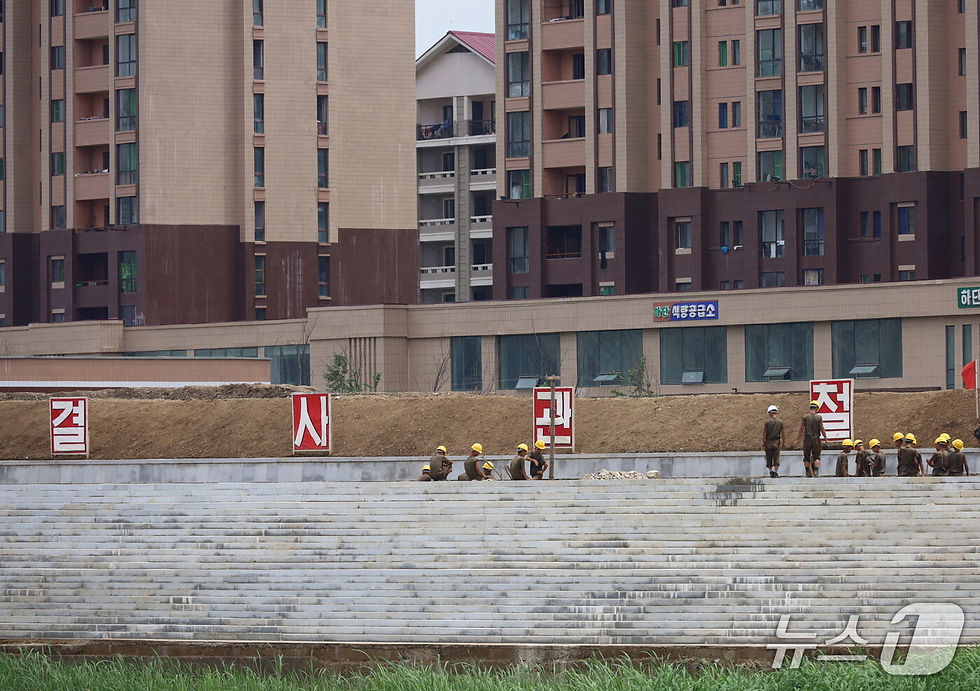 North Korean military construction personnel carrying out embankment and road maintenance work in front of the newly built Wihwado housing complex. A food distribution center and hospital, built on the second floor of the housing complex, are visible. (Photo courtesy of the Peace Economy Research Institute) |
A guide residing in Dandong told the author, "Military construction personnel and youth shock-brigade members worked around the clock to complete the housing construction in 130 days; they are now carrying out some finishing work as well as embankment and road maintenance projects."
Indeed, viewed up close from the tour boat, the Wihwado area was still under construction in places. In housing units where interior work had already been completed, residents had already moved in, with some seen hanging laundry or cleaning.
On the spacious site, a newly built five-story Hadan Senior Middle School and a cultural center had been constructed, while the second floor of the housing complex housed various convenience and service facilities, including shops, a library, a tailor shop, a food distribution center, a pharmacy, and an information technology service room.
 The new housing complex on Wihwado, Sinuiju City, North Pyongan Province, with part of Dandong City, China, visible in the background. North Korea concentrated high-rise buildings along the northern shore of Wihwado, facing Dandong across the Amnok River, apparently for external propaganda effect. (Photo courtesy of the Peace Economy Research Institute) |
A 5-meter-high flood-prevention embankment has been built along the Wihwado riverbank — a measure intended to fundamentally prevent the periodic flood damage that has recurred in the area. The placement of pilotis (open ground-floor structures) or storage spaces on the first floor of residential buildings also appeared designed to prepare for flooding during heavy rainfall.
The exterior walls of the housing and public buildings were finished in a harmonious mix of brown, orange, and white, varied vertically or by floor, giving an overall impression reminiscent of a small Chinese city. Building heights along the riverside were also varied — from roughly 15-story high-rises down to 5-story buildings — with mid- and low-rise apartment blocks and detached houses placed further inland, evidently designed to create an imposing visual impression when viewed from the Dandong side.
 The new housing complex on Wihwado, Sinuiju City. With housing construction complete, finishing work continues on the 5-meter embankment, roads, and other infrastructure. (Photo courtesy of the Peace Economy Research Institute) |
At the construction site, a propaganda banner was also erected, reading: "Let us glorify the 9th Party Congress as a Congress of Victors, a Congress of Glory!" This suggests that North Korea intends to complete construction before the 9th Congress of the Korean Workers' Party, scheduled for late December of this year or January of next year.
Looking toward the China-Korea Friendship Bridge (Sino-Korean Friendship Bridge) from the tour boat, trucks bound from Dandong to Sinuiju could be seen in an unbroken line. A freight train traveling from P'yŏngyang's Sŏp'o Station into Dandong was also spotted — service that had been suspended for some time before recently resuming. Could this signal a thaw in China-North Korea relations, which had cooled over the past year?
 Trucks crossing the China-Korea Friendship Bridge from Dandong City into Sinuiju. (Photo courtesy of the Peace Economy Research Institute) |
A businessman in Dandong told the author, "Logistics through the Dandong-Sinuiju route still haven't recovered to pre-COVID-19 levels, but cargo volume is gradually increasing," expressing optimism about expanding China-North Korea trade.
Regarding the deadlocked inter-Korean relationship, he offered the following assessment: "North Korea has declared an 'antagonistic two-state relationship' and stated that 'inter-Korean dialogue is over forever,' but judging from conversations with North Korean trade officials stationed in Dandong, some positive shifts are also emerging. If South Korea's new government takes forward-looking steps to rebuild trust before the 9th Party Congress, it is not entirely out of the question that North Korea could come to the table for talks."
About the Author
Jung Chang-hyun | Director, Peace Economy Research Institute Historian and journalist. Graduated from the Department of Korean History, Seoul National University; completed doctoral coursework at the same institution. Currently Director of the Peace Economy Research Institute. Has pursued research, writing, and journalistic activities in the fields of inter-Korean relations and modern North Korean history for nearly 30 years. |


Comments