
North Korea’s Shift to Supermarket-Style Stores— Transformation into Stores Where Customers Select Goods Themselves
- Mar 18
- 2 min read
In 2012, with investment from a Chinese company, a large-scale supermarket named “Kwangbok Area Commercial Center” was established in Pyongyang for the first time. Through this, a “supermarket-style system” was introduced in North Korea, allowing customers to move freely within stores, select the goods they need, and leave only the payment process to sales staff.
In North Korea, supermarkets are referred to as “large-scale retail shops,” and are defined as “consumer sales hubs that introduce a self-service system in sales counters for food, textiles, clothing, and sports goods, with the aim of lowering distribution costs and increasing turnover rates.”
Starting with the Kwangbok Area Commercial Center, newly emerging “supermarket-style stores” computerized all processes, including stocking, storage, distribution, sales, and payment. All products were equipped with barcodes, enabling immediate identification of product types, quantities, and sales performance. In addition, store interiors were designed similarly to large discount stores or corporate supermarkets (SSMs) in South Korea, allowing customers to shop using carts or baskets.

Expansion of the Supermarket Model Nationwide
As the newly introduced supermarket-style stores proved convenient and their usage by residents increased, North Korea began expanding this model nationwide.
In 2020, North Korea stated that it was “encouraging advanced and diverse activities that prioritize consumer convenience,” and announced that it was improving commercial service networks across the country by adopting the supermarket-style system.
With the introduction of this system, North Korea has emphasized improving people’s living standards and ensuring practical benefits. To this end, supermarket-style stores have set as their basic goal “to meet the demand for essential daily necessities that are widely used in workers’ consumption life, including food, daily goods, and household items.”
This resembles corporate-style supermarkets commonly found in neighborhoods in South Korea.
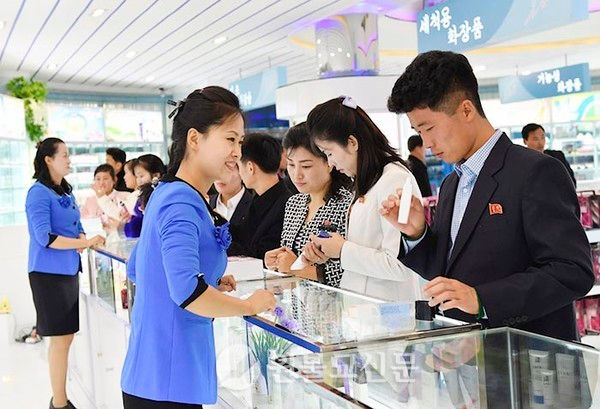
Familiar to Us, a New World for North Korean Residents
Smartphones in North Korea come equipped by default with fintech-based simple payment applications similar to Samsung Pay or KakaoPay.
An application called “Ullim” includes functions such as remittance, card payment, prepaid charging, and e-commerce services. North Korea predicts that product sales through e-commerce (electronic commerce) will “dominate the global commodity market in the near future,” and states that it will “actively promote efforts to significantly reduce management costs in the commercial sector and improve the distribution system.”
Although delivery infrastructure is not yet fully established and remains at an early stage, “delivery services” are gradually expanding.
What is entirely familiar and routine—like the concept expressed in the phrase “Baedal Minjok” (delivery culture)—is becoming a “new world” that is only now unfolding for North Korean residents. Source: Chung Chang-hyun, Director of the Peace Economy Research Institute Chung Chang-hyun is Director of the Peace Economy Research Institute. He holds a master’s degree in Korean history from Seoul National University and previously worked as a senior journalist at the JoongAng Ilbo Institute of Contemporary History.


Comments