
Key Third-Generation Officials to Lead “Kim Jong Un’s Third Term”
- Apr 2
- 4 min read
March 25, 2026

North Korea has completed leadership appointments in the party, government, and military that will lead “Kim Jong Un’s third term” through the 9th Congress of the Workers’ Party (February 19–25) and the 1st Session of the 15th Supreme People’s Assembly (March 22–23).
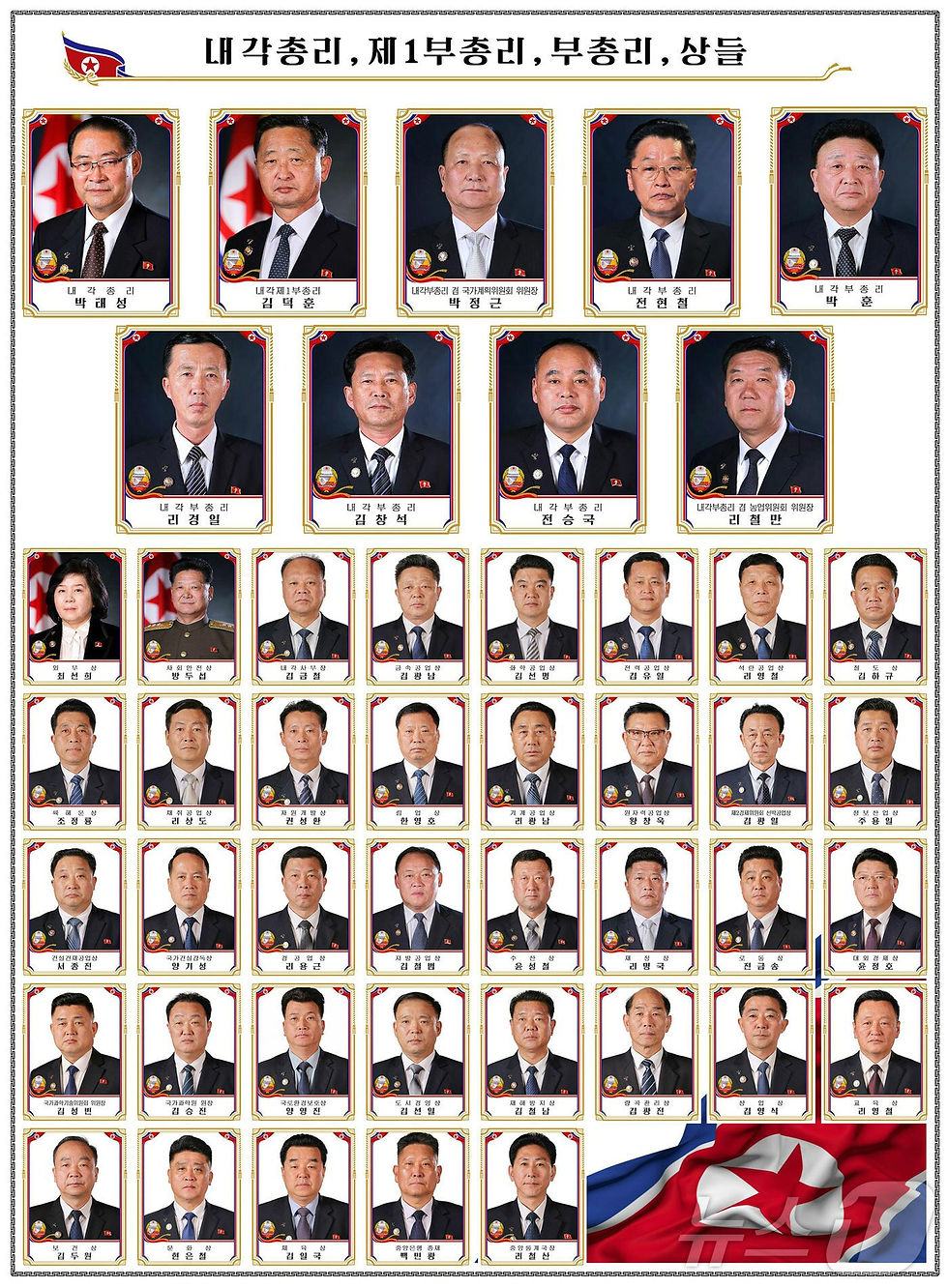
Kim Jong Un was reappointed as General Secretary of the Workers’ Party and Chairman of the State Affairs Commission. Pak Thae-song retained his position as Premier of the Cabinet, while Jo Yong-won, former Organizational Secretary of the Workers’ Party, was newly elected as Chairman of the Supreme People’s Assembly and Chairman of its Standing Committee.
These three, along with newly appointed Organizational Secretary Kim Jae-ryong and Propaganda Secretary Ri Il-hwan, form the Presidium of the Politburo. The Presidium is the highest decision-making body of the Workers’ Party, responsible for “deliberating and deciding urgent and important issues arising politically, economically, and militarily.”
Through this reshuffle of party, government, and military personnel, it is assessed that General Secretary Kim Jong Un’s direct governing system has been further solidified.
Rise of Third-Generation Officials
First, senior figures in their 70s—such as Ri Pyong-chol, Pak Jong-chon, and Choe Ryong-hae—who were the last of the “second-generation revolutionaries” that assisted Kim Jong Un in the early stage of his leadership since 2012, have stepped down.
In their place, third-generation officials in their 60s, who worked closely with Kim during his first and second terms, have risen to top positions in the party, government, and military. This marks a transition from the generation that grew through the Chollima Movement of the 1950s–60s to the generation that emerged through the “Three Revolutions Team Movement” of the 1970s–80s.
Second, the advancement of officials from the Organization and Guidance Department—who have closely assisted Kim Jong Un—is notable. These include Jo Yong-won, Vice Chairman of the State Affairs Commission; Premier Pak Thae-song; Organizational Secretary Kim Jae-ryong; Cadres Affairs Secretary Ri Hi-yong; and Vice Chairman of the SPA Standing Committee Kim Hyong-sik.

Strengthened Party Control over the Military
Third, party control over the military has been strengthened, and generational replacement within the military has accelerated. Officials who became generals after the launch of Kim Jong Un’s leadership have been appointed to key positions in the Ministry of Defense, General Political Bureau, General Staff Department, and various corps.
Notably, none of the five members of the 9th Politburo Presidium come from the military. In the past, one or two members were typically selected from military ranks, but in this case, military figures were excluded and replaced by a secretary in charge of propaganda and agitation.
In particular, replacing former Chief of the General Staff Pak Jong-chon, Jong Kyong-thaek, former Director of the General Political Bureau, was appointed as Secretary of the Party Central Committee and head of the Military Affairs Guidance Department, as well as Vice Chairman of the Central Military Commission. This symbolically shows that political and ideological control by the party is being prioritized over military command and operational expertise.
Emergence of Fourth-Generation Military Leadership
At the frontline level, generational change among corps commanders has progressed gradually, with officials in their 40s—considered the fourth generation—emerging as the main group.
Recently appointed corps commanders, including Ju Song-nam (2nd Corps), Jong Myong-nam (4th Corps), Ri Jong-guk (5th Corps), Hong Chol-ung (7th Corps), and Ji Yong-bok (9th Corps), are all figures who were personally promoted by Kim Jong Un in the late 2010s.
For example, An Yong-hwan, commander of the 1st Corps, was promoted in April 2019. Unlike the past, the rank of corps commanders has been lowered from colon general (three-star) to lieutenant general (two-star), and the commander of the 91st Corps, responsible for defending Pyongyang, has been downgraded by two ranks from lieutenant general to senior colon.
It is also reported that many military officials promoted after the launch of Kim Jong Un’s leadership studied together with him at Kim Il Sung Military University, where he attended regular and research courses from 2002. The June 2023 issue of the North Korean literary magazine Choson Munhak introduced an account of Kim strengthening camaraderie with his classmates in December 2003 while pounding rice cakes together.
Structural Trends Across Party, Government, and Military
Within the party, officials from the Organization and Guidance Department are advancing; within the Cabinet, professional economic technocrats with extensive field experience are rising; and within the military, graduates of Kim Il Sung Military University are gaining prominence.
Meanwhile, although the position of “First Secretary of the Party Central Committee”—which acts on behalf of the General Secretary—was created at the 8th Party Congress in 2021, no First Secretary was appointed at the 9th Party Congress.
Some experts believe that the position was created with succession in mind for Kim Ju-ae, but at present, it is presumed that Kim Yo-jong, Director of the General Affairs Department, is effectively performing that role. She, who was reappointed as an alternate member of the Politburo after five years, is reportedly expanding the role of the General Affairs Department and partially engaging in the work of the Organization and Guidance Department and the Secretariat.
Kim Ju-ae, who had drawn particular attention, did not appear at the 9th Party Congress and only attended the commemorative military parade after the congress. This indicates that she has not yet been officially designated as a successor.
🌍 Source: News1(“Reading North Korea” column by Jung Chang-hyun)
Jung Chang-hyun Director of the Peace Economy Institute
He completed his graduate studies in Korean history at Seoul National University, and served as a senior reporter at the Institute of Contemporary History of JoongAng Ilbo. He also served as an adjunct professor at Kookmin University and University of North Korean Studies, and as an advisory committee member of the National Archives of Korea.


Comments